
K-Cup Pods, Keurig Brewers and the Truth About Coffee Pod Recycling
K-Cup pods have transformed the way millions of people prepare coffee at home and in the workplace. With a Keurig brewer, a single cup of coffee can be prepared in less than a few minutes with little mess and almost no preparation.
Unlike other ways of brewing coffee which take more time like French press, Vietnamese phin filter, a coffee capsule brewer can brew coffee as fast as a lightning.
But the convenience of single-serve coffee comes with an important question: What happens to the K-Cup pod after the coffee has been brewed?
For years, coffee pods were criticized because their small size and combination of materials made them difficult to recycle. Today, the situation is more complicated. Keurig says that all K-Cup pods it produces have been made from recyclable polypropylene (#5 plastic) since 2020. However, a recyclable pod is not necessarily a pod that can be recycled everywhere. Local collection systems, sorting equipment and recycling facilities determine whether a used K-Cup can actually enter the recycling stream.
It is no doubt that the coffee capsules at the very first beginning were marketed as a "premium coffee pods" with aluminum foiled capsules which make them look very luxirious and high-end. It is not only to preserve coffee inside better but also to enhance customer's experiences. Now if the producers change from the old one to recycle one, that could be very challenging for them.
This makes K-Cup recycling an interesting example of the difference between designing packaging to be recyclable and actually recycling that packaging at scale.
What Is a K-Cup Pod?
A K-Cup® pod is a single-serving coffee pod designed for use with Keurig® brewing systems. It contains ground coffee inside a small sealed container and is designed to deliver one serving of brewed coffee.
Although people often use the terms K-Cup, coffee pod and coffee capsule interchangeably, they are not technically identical. K-Cup® is a trademark associated with Keurig, while coffee pod and coffee capsule are broader terms used throughout the coffee industry.
A typical K-Cup system combines several components, including:
A polypropylene plastic cup
A filter containing the ground coffee
A foil lid
Coffee grounds
The exact construction can vary among products and manufacturers.
The original K-Cup design also evolved over time. Keurig's current K-Cup pods use polypropylene (#5 plastic), a material selected because it is compatible with the brewing process and can be processed by many recycling systems.
For those who don't like to have "plastic" in their daily morning coffee rituals, change your mind to plastic - free coffee brewing methods like Vietnamese coffee phin filter or dripper.
How Does a Keurig Brewer Work?
The basic brewing process is remarkably simple.
First, the user inserts a K-Cup pod into the brewer and closes the lid. The machine punctures the pod and introduces hot water through the coffee grounds.
The water passes through the ground coffee, extracting soluble compounds responsible for the coffee's aroma, flavor, color and body. The brewed coffee then flows through the bottom of the pod and into a cup.
The process is automated, which is one of the main reasons single-serve coffee became so popular. And your perfect cup of Joe will be delivered in seconds.
Why Are K-Cup Brewers So Popular?
The appeal of a Keurig-style brewing system comes from several factors:
Convenience: little preparation is required.
Speed: one cup can be brewed quickly.
Consistency: each pod contains a controlled quantity of coffee.
Variety: consumers can choose from many coffee blends and beverage styles.
Portion control: one pod is designed for one serving.
Low cleanup: there is no need to handle loose coffee grounds in the brewing chamber.
For households, offices and other environments where different people want different beverages, single-serve brewing can be particularly convenient.
What Are K-Cup Pods Made Of?
One of the most important developments in K-Cup packaging has been the move to polypropylene.
According to Keurig, all K-Cup pods it produces have been made from polypropylene (#5 or PP plastic) since the end of 2020. Polypropylene is widely used in food and household packaging, including products such as yogurt containers and butter tubs.
The change was significant because earlier K-Cup designs used materials that were more difficult to recycle. Keurig's transition involved converting more than 100 manufacturing lines to produce the new recyclable pod format.
However, the word “recyclable” needs some explanation.
A product can be technically recyclable but still not be accepted by a particular municipal recycling program.
Are K-Cup Pods Recyclable?
Yes, current Keurig K-Cup pods are designed to be recyclable. But they are not necessarily accepted everywhere.
Keurig specifically advises consumers to check their local recycling program because some facilities that accept polypropylene do not accept small coffee pods. The company notes that recycling systems differ significantly from one community to another.
This distinction is important:
Recyclable ≠ automatically recycled.
For a used K-Cup pod to become recycled material, several things need to happen:
The consumer must place it in an appropriate recycling stream.
The local program must accept K-Cup pods.
The pod must be successfully sorted at the recycling facility.
The material must be processed by a recycler.
There must be a market for the recovered polypropylene.
If any of these steps fails, the pod may ultimately be disposed of instead.
Research on coffee capsules also highlights this broader challenge: recyclability depends not only on the material itself but also on collection, sorting and end-of-life infrastructure.
How to Recycle a K-Cup Pod
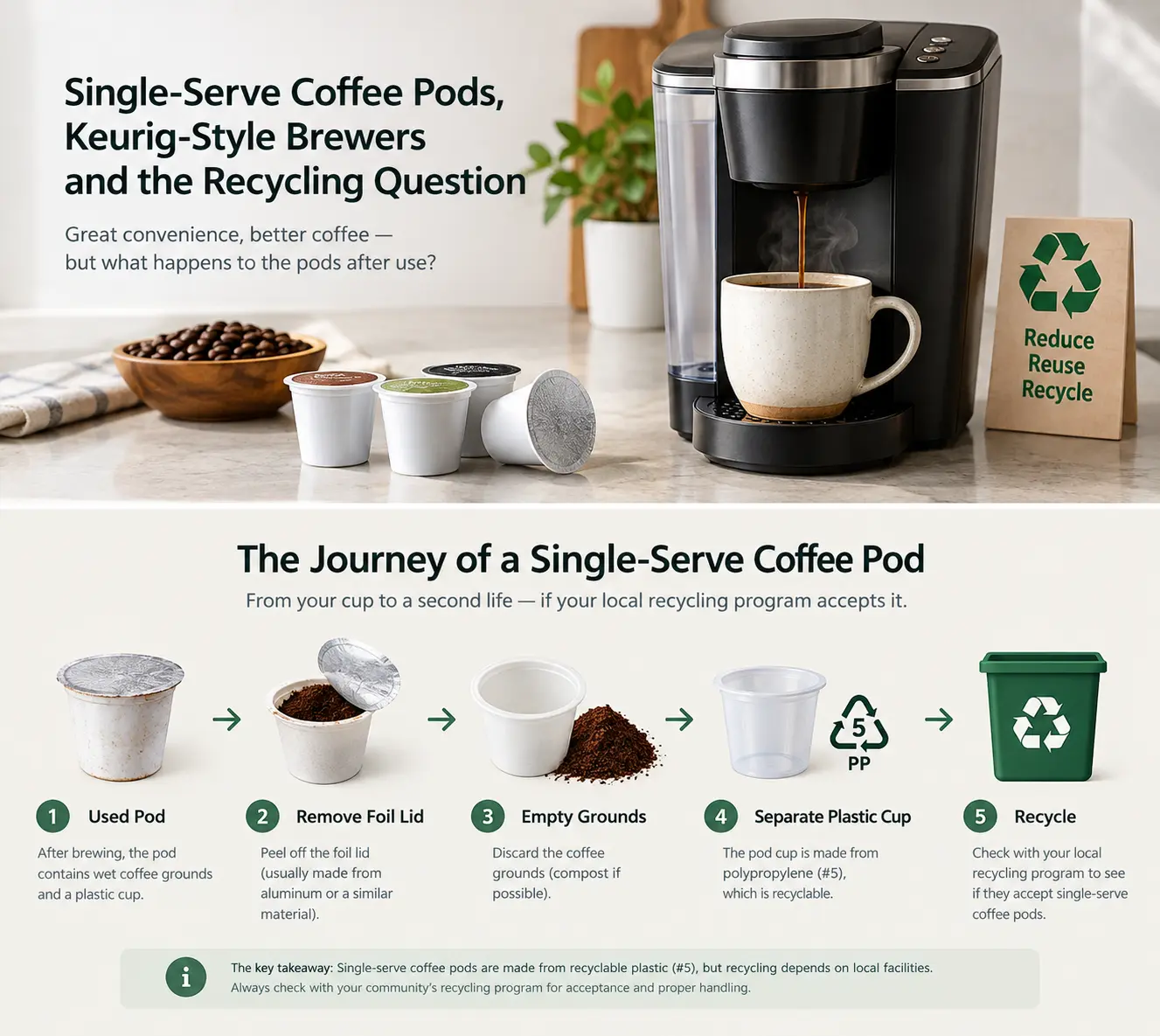
If your local recycling program accepts K-Cup pods, Keurig currently recommends a simple preparation process.
1. Let the used pod cool
After brewing, allow the pod to cool before handling it.
2. Remove the foil lid
Peel the foil lid away from the pod.
3. Empty the coffee grounds
Remove the used coffee grounds. Depending on local rules, coffee grounds may be composted or disposed of with household waste.
4. Check the local recycling rules
The empty polypropylene cup can potentially enter the recycling stream, but check your local recycling program first.
Do not assume that the recycling symbol on the package means your local facility accepts the item.
Keurig also offers a mail-in K-Cycle® recycling option for consumers in areas where local recycling programs do not accept the pods. Availability and program details should be checked directly with Keurig.
Why Are K-Cup Pods Difficult to Recycle?
The challenge is not simply the type of plastic.
Coffee pods are small, lightweight and composed of multiple components. A used pod can contain plastic, a foil lid, a filter and wet coffee grounds.
Recycling facilities are designed to process large volumes of different materials at high speed. Small items can be more difficult to capture and sort than larger containers.
This means that even when polypropylene is technically recyclable, the actual recovery rate can depend heavily on the local recycling infrastructure.
Keurig has worked with recycling organizations and material recovery facilities to improve the ability of recycling systems to identify and recover polypropylene K-Cup pods. The company has also invested in the Polypropylene Recycling Coalition to expand polypropylene recycling infrastructure.
Are K-Cups Bad for the Environment?
There is no simple yes-or-no answer.
Single-use coffee pods create packaging waste because the container is discarded after one serving. Even when the plastic is recyclable, producing the packaging requires materials and energy, and successful recycling depends on collection and processing infrastructure.
At the same time, environmental performance should not be judged only by the pod itself.
A life-cycle assessment considers the entire system, including coffee production, packaging, transportation, brewing and end-of-life treatment. The research about "improving coffee capsules recyclability" published in 2024 found that the environmental performance of coffee capsules can vary significantly depending on the material and what happens to that material at the end of its useful life. Polypropylene performed more favorably when high recovery of the material was assumed.
This is why the sustainability discussion around coffee capsules is more nuanced than simply asking whether a pod contains plastic.
Are polypropylene K-Cups Bad for your coffee taste?
Although polypropylene (aka number 5 or PP plastic) is advertised as "a widely used thermoplastic polymer made from propylene gas. It is the second-most-produced plastic in the world" with a strong chemical resistant against water, oils, greases, acids, and alkalis and a high melting point which withstands heat up to 160–170°C, and especially described as "odor - free" (or in other word, without smell), it might affect the coffee taste or aroma in some way and in some extent. Or, at least, a guru coffee drinker might feel or has a feeling of unfamiliar taste with that. That's why many coffee drinkers are willing to pay thousands of dollars to buy an espresso machine for their own.
By the way, will the number 5 plastic coffee capsules will generate micro-plastics or not? When the coffee pods puncture the capusules to make some holes for hot water delivering through, will the action force some microplastic particles broken out and join the water stream? These matters should be researched carefully by the scientists.
Recyclable Does Not Mean Reusable
Another important distinction is between recyclable and reusable.
A recyclable K-Cup is designed to be processed into another material after use. A reusable coffee pod, on the other hand, is designed to be filled and brewed repeatedly.
These are different approaches to reducing waste.
Reusable systems can potentially reduce the amount of single-use packaging generated, while recyclable systems attempt to recover material after the product has been used.
The environmental outcome depends on many factors, including how often reusable equipment is used, how it is cleaned, what materials are involved and how efficiently disposable packaging is collected and recycled.
What Happens to Recycled Polypropylene?
Recovered polypropylene can be processed into recycled plastic feedstock and used in new products.
Keurig says recycled polypropylene can have applications including automotive parts, children's products, storage containers and outdoor furniture.
Researchers are also investigating more advanced ways to recover value from spent coffee capsules.
For example, a 2024 study described a process that combines spent coffee grounds with polypropylene components to produce recycled composite material that could potentially be used to manufacture new capsule shells.
More recently, research published in 2026 investigated hydrothermal liquefaction as a potential method for converting spent K-Cup components into useful products. These technologies are still part of the broader research and development landscape rather than a standard household recycling solution.
K-Cup Recycling: The Bigger Lesson for the Coffee Industry
The K-Cup story illustrates an important issue facing the modern coffee industry.
Coffee packaging has to balance several competing requirements:
Protecting coffee from oxygen, moisture and light
Preserving aroma and freshness
Maintaining food safety
Providing convenient preparation
Reducing material use
Making packaging recyclable
Creating practical recycling systems
Changing the material is only one part of the solution.
For a package to participate in a circular economy, there must also be collection infrastructure, sorting technology, processing capacity and demand for recycled material.
This is why “designed for recycling” and “recycled in practice” are not necessarily the same thing.
Frequently Asked Questions About K-Cup Pods
Are all K-Cup pods recyclable?
Keurig states that all K-Cup pods it produces have been made from recyclable polypropylene (#5 plastic since 2020). However, not every local recycling program accepts K-Cup pods. Always check local requirements.
What number plastic is a K-Cup?
Current Keurig K-Cup pods are made from polypropylene, identified as #5 plastic.
Can I put K-Cups in my recycling bin?
Only if your local recycling program accepts K-Cup pods. The presence of a recyclable-material designation does not guarantee that your local facility accepts small coffee pods.
Should I remove the foil lid before recycling?
Yes. Keurig recommends peeling off the foil lid, emptying the coffee grounds and then checking whether the empty cup is accepted by your local recycling program.
Can K-Cup coffee grounds be composted?
Used coffee grounds are organic material and can generally be composted where suitable composting facilities or home composting systems are available. However, local composting rules vary.
Are K-Cups biodegradable?
Standard polypropylene K-Cup pods should not be described as biodegradable. They are designed for material recycling rather than biological decomposition.
Are K-Cups environmentally friendly?
Their environmental impact depends on the complete life cycle of the coffee and packaging, including material production, transportation, brewing and end-of-life treatment. A recyclable design can improve the end-of-life option, but recycling depends on local infrastructure and actual recovery.
Final Thoughts
K-Cup pods have changed coffee preparation by making single-serve brewing fast, convenient and consistent. At the same time, their disposable nature has created legitimate questions about packaging waste and recycling.
The good news is that today's K-Cup pods are fundamentally different from the early generations of the product. Keurig says its K-Cup pods have been made from recyclable polypropylene since 2020.
The remaining challenge is recycling in practice.
A K-Cup pod may be recyclable by design, but it still needs to be collected, sorted and processed correctly. For consumers, the most responsible approach is therefore simple: check local recycling rules, prepare the pod correctly and avoid putting it into the recycling bin when your local program does not accept it.
The future of coffee packaging will likely depend not on one material or one brewing technology, but on how effectively the coffee industry can combine convenience, product protection, material efficiency and genuine circularity.