
Green Coffee Bean Extract for Weight Loss: What Does the Evidence Say?
Green coffee bean extract has attracted considerable attention as a natural ingredient associated with weight management. Unlike roasted coffee, green coffee beans are unroasted and retain higher levels of chlorogenic acids, a group of naturally occurring polyphenols that have been studied for their possible effects on glucose metabolism, fat metabolism, and body weight.
But does green coffee bean extract actually help people lose weight?
The answer is more nuanced than many advertisements suggest. Some clinical studies and meta-analyses have reported modest reductions in body weight or body mass index, while other research has found limited or uncertain effects. Major health authorities also emphasize that the evidence is not strong enough to consider weight-loss supplements a substitute for a healthy diet, appropriate calorie intake, and physical activity.
There is also an important distinction between green coffee bean extract and ordinary brewed coffee. Coffee that has been roasted, ground and brewed still contains caffeine and chlorogenic acids, but roasting and brewing change their amounts and availability.
This article reviews what is currently known about green coffee bean extract, chlorogenic acid, caffeine, roasted coffee, espresso and their possible relationship with weight management.
What Is Green Coffee?
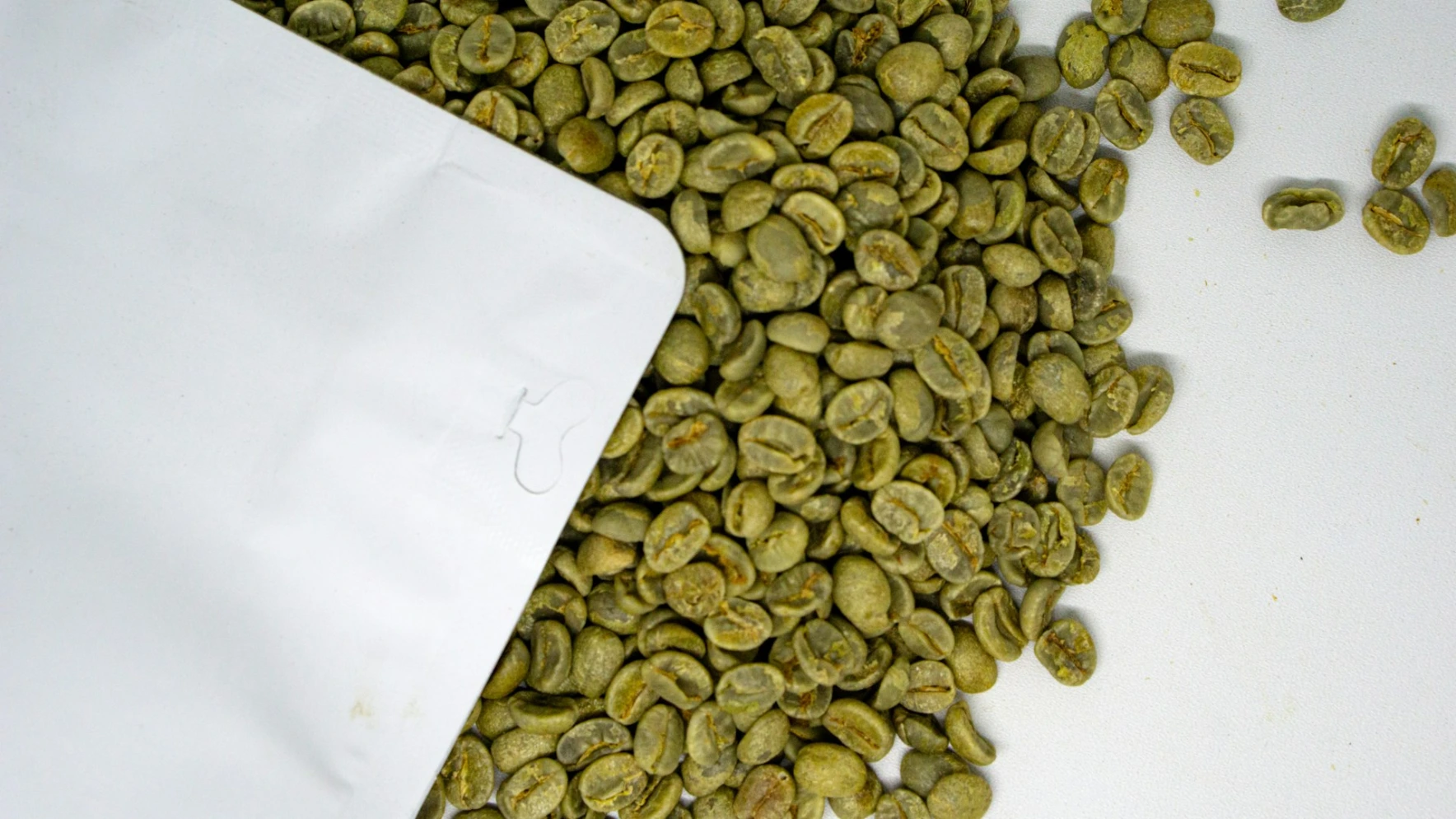
Green coffee refers to coffee beans that have not yet been roasted.
Coffee beans naturally contain a number of compounds, including caffeine and chlorogenic acids. Roasting changes the chemical composition of coffee and generally reduces the amount of chlorogenic acids compared with unroasted beans.
Green coffee bean extract is produced by extracting compounds from unroasted coffee beans and is commonly sold as a dietary supplement in capsules, tablets, powders, or functional food products.
It is important to distinguish green coffee beans from green coffee bean extract.
Green coffee beans are simply unroasted coffee beans. An extract is a concentrated preparation that may contain specific amounts of chlorogenic acids and caffeine, depending on how it is produced.
Simply saying, we need a lot more of green coffee beans to produce green coffee bean extract.
What Is Chlorogenic Acid?
Chlorogenic acids (CGAs) are a group of polyphenolic compounds naturally present in coffee.
They are particularly abundant in green coffee beans. During roasting, some chlorogenic acids are transformed or degraded, which means the composition of roasted coffee is different from that of green coffee.
Research has investigated chlorogenic acids because laboratory and human studies suggest they may influence several metabolic processes, including glucose absorption and lipid metabolism.
However, biological activity in laboratory experiments does not automatically mean that consuming a supplement or coffee beverage will produce a meaningful amount of weight loss in humans.
This distinction is important when evaluating claims about green coffee and weight management.
How Might Green Coffee Extract Affect Body Weight?
Several mechanisms have been proposed to explain why green coffee extract might influence body weight.
Researchers have investigated whether chlorogenic acids may:
Influence glucose absorption and metabolism
Affect lipid metabolism
Reduce the accumulation of fat
Influence energy metabolism
Affect body fat distribution
Interact with metabolic pathways involved in weight regulation
Caffeine may also contribute to some physiological effects because green coffee naturally contains caffeine.
However, these proposed mechanisms should not be confused with proof of significant weight loss in humans.
The key question is what happens in well-designed clinical trials.
What Does the Research Say About Green Coffee and Weight Loss?
The scientific evidence is mixed, although several systematic reviews have reported small effects.
An early systematic review and meta-analysis identified only three suitable clinical trials and found a statistically significant difference in body weight between green coffee extract and placebo. However, the researchers emphasized that the studies had a high risk of bias and that more rigorous trials were needed.
A 2019 systematic review and dose-response meta-analysis included 16 randomized controlled trials from 13 articles. It found a small reduction in BMI, but the overall change in body weight was not statistically significant.
A later 2020 meta-analysis included 15 randomized clinical trials involving 897 participants. It reported average reductions of approximately 1.23 kg in body weight, 0.48 kg/m² in BMI and 1 cm in waist circumference. However, the authors also called for additional well-designed studies.
A 2023 systematic review and meta-analysis specifically examined green coffee bean extract containing chlorogenic acids. Only three randomized controlled trials involving 103 participants were included. The analysis found an average body-weight reduction of approximately 1.30 kg when the extract provided at least 500 mg of chlorogenic acids per day. However, the authors emphasized the small sample size and short duration of the available studies and called for longer-term research.
These findings suggest that an effect may exist, but the magnitude appears relatively small and the evidence remains limited.
Green Coffee Extract Is Not a Magic Weight-Loss Solution
The popularity of green coffee extract increased dramatically after television programs and online marketers promoted it as a rapid weight-loss product.
Some marketing campaigns claimed that people could lose large amounts of weight without changing their diet or exercising.
Those claims were not supported by reliable scientific evidence.
In 2014, the U.S. Federal Trade Commission (FTC) took action against marketers of green coffee products over allegedly deceptive weight-loss claims and the use of misleading websites and purported clinical evidence.
The FTC also reached a settlement with a manufacturer over weight-loss claims based on a study that the agency described as seriously flawed.
These cases do not mean that all research on green coffee is invalid. They demonstrate why consumers should distinguish between scientific evidence and commercial marketing claims.
Green Coffee Extract vs. Ordinary Coffee
This distinction is especially important for coffee readers.
A concentrated green coffee bean extract is not the same thing as drinking a cup of roasted coffee.
A supplement can be formulated to deliver a specified amount of chlorogenic acids and caffeine, while the composition of a coffee beverage depends on the species, variety, origin, roast level, dose of ground coffee, grind size, water temperature, extraction method and serving size.
Consequently, it is not scientifically appropriate to assume that drinking a particular type of coffee will produce the same weight-loss effect reported in a study using a concentrated extract.
Does Roasting Destroy the Potential Benefits of Coffee?
Roasting changes the chemical composition of coffee, but it does not remove all chlorogenic acids or caffeine.
Research has shown that chlorogenic acids generally decline as roasting becomes more intense, while caffeine is considerably more stable during roasting. One study examining different roasting levels found progressive reductions in chlorogenic acids with increasing roast intensity.
This means that green coffee is generally richer in chlorogenic acids than roasted coffee, but it would be incorrect to conclude that dark-roasted coffee has no potentially relevant bioactive compounds.
Roasted coffee contains a complex mixture of compounds created or transformed during roasting, including melanoidins, chlorogenic-acid derivatives, caffeine and other bioactive substances.
Therefore, the relationship between roast level and health effects is more complicated than simply saying "lighter is better" or "green is better."
Can Plain Black Coffee Help With Weight Management?
This is where coffee and weight loss become particularly interesting.
Plain coffee without added sugar, syrups, cream or high-calorie milk is a very low-calorie beverage. Its caffeine content may also have short-term effects on energy expenditure and fat oxidation.
A systematic review and meta-analysis of 13 randomized controlled trials involving 606 participants found that caffeine intake could promote reductions in body weight, BMI and fat mass. However, the studies showed substantial variation, and the authors did not establish that drinking a particular coffee preparation would produce a specific amount of long-term weight loss.
More recent evidence is considerably more cautious.
A 2024 systematic review and network meta-analysis of randomized trials compared several tea and coffee interventions. The researchers found evidence for a small weight-loss effect with green tea, but did not find a statistically significant weight-loss effect for coffee, decaffeinated coffee or green coffee beverages in the included trials. The authors rated much of the evidence as low or very low certainty and noted that only a small number of studies examined longer intervention periods.
This is an important reason to avoid saying that "coffee burns fat" as though the effect were established.
A more defensible statement is:
Caffeine may have short-term metabolic effects, while the evidence that ordinary coffee consumption produces meaningful long-term weight loss remains uncertain.
What About Coffee Without Sugar and Milk?
If the objective is weight management, the biggest practical advantage of plain coffee may be its low calorie content, rather than a powerful fat-burning effect.
Black coffee without added sugar, condensed milk, cream, flavored syrup or other calorie-dense ingredients can provide a coffee experience with very few calories.
By contrast, adding significant amounts of sugar, condensed milk, cream or flavored syrups can substantially increase the energy content of the beverage.
Therefore, from a calorie-control perspective, the difference between:
plain black coffee
and
coffee with sugar, condensed milk, cream or syrup
may be more relevant to daily energy intake than the difference between espresso and other brewing methods.

This does not mean that adding milk automatically prevents weight loss. Milk especially skim milk can be part of a healthy diet. The important consideration is the total amount of calories consumed relative to individual energy requirements.
Does Espresso Have a Special Weight-Loss Advantage?
Espresso is sometimes described online as a particularly effective coffee for weight loss because it is concentrated and contains caffeine and chlorogenic acids.
However, there is currently not enough clinical evidence to conclude that espresso causes more weight loss than other forms of plain coffee.
Espresso is a brewing method, not a separate type of coffee.
The chemical composition of espresso depends on:
Coffee species and variety
Roast level
Dose of ground coffee
Grind size
Water temperature
Extraction time
Pressure
Serving volume
Blend composition
Analytical studies show that espresso can contain relatively high concentrations of caffeine and chlorogenic acids per milliliter because a small volume of water extracts compounds from a relatively concentrated coffee dose.
However, concentration per milliliter is not the same as total intake per serving.
For example, a 30 mL espresso shot is much smaller than a typical filter coffee. Depending on the recipe, serving size and coffee dose, the total caffeine and chlorogenic acids consumed can be quite different.
Research examining commercial espresso coffees has also found substantial variation in caffeine and chlorogenic-acid content from one coffee to another.
Therefore:
Espresso may provide caffeine and chlorogenic acids, but there is no strong evidence that espresso itself is a superior weight-loss beverage.
What About Naturally Roasted Coffee?
The phrase "naturally roasted coffee" or "pure roasted coffee" generally refers to coffee roasted without added ingredients such as sugar, butter, flavoring or other substances.
From a weight-management perspective, the key point is not that "natural roasting burns more fat."
Rather, plain roasted coffee can remain a very low-calorie beverage when consumed without calorie-dense additions.
Roasting also does not eliminate caffeine. Chlorogenic acids do decline with roasting, particularly as roast intensity increases, but roasted coffee still contains chlorogenic acids and other bioactive compounds.
Consequently, light, medium and dark roasts should not be presented as different levels of weight-loss effectiveness. There is not sufficient clinical evidence to make such a ranking.
The choice of roast should primarily be based on flavor preference, coffee origin, brewing method and sensory characteristics rather than an assumption about greater fat-burning ability.
Does the Brewing Method Matter?
Yes—but mainly because brewing changes the chemical composition and concentration of the beverage.
Research comparing espresso, moka, French press, V60, AeroPress, cold brew and other extraction methods found substantial differences in caffeine and chlorogenic-acid concentrations. In one study using the same raw coffee material, espresso had among the highest concentrations of these compounds per milliliter, while larger-volume beverages could deliver higher total amounts per serving because much more beverage was consumed.
This illustrates an important principle:
Coffee concentration, serving size and total intake are different measurements.
A strong espresso may contain more caffeine per milliliter than filter coffee, but that does not automatically mean that drinking espresso results in greater fat loss.
There is currently no strong clinical evidence establishing a hierarchy such as:
espresso > filter coffee > French press > Vietnamese phin filter > other coffee
for long-term weight loss.
A Practical Comparison of Coffee and Weight Management
The following comparison summarizes what can reasonably be said from current evidence.
| Coffee or preparation | Potential relevance to weight management | What the evidence actually supports |
|---|---|---|
| Green coffee bean extract | Possible modest effect | Some RCTs and meta-analyses report small reductions, but evidence is limited and heterogeneous |
| Green coffee beans as a beverage | Possible metabolic effects | Contains chlorogenic acids, but evidence for meaningful weight loss from the beverage is uncertain |
| Plain roasted coffee | Possible small contribution through caffeine and low calories | Caffeine has metabolic effects, but long-term weight-loss evidence for ordinary coffee is uncertain |
| Light/medium roast | Contains more chlorogenic acids than darker roast in general | More CGA does not automatically mean more weight loss |
| Dark roast | Generally lower in chlorogenic acids than lighter roast | Still contains caffeine and many other bioactive compounds |
| Plain espresso | Concentrated source of coffee compounds | No good evidence that espresso itself produces greater weight loss |
| Filter coffee | Can provide caffeine and chlorogenic acids | No established weight-loss advantage over espresso |
| Coffee with sugar/syrup | Adds calories | May make calorie control more difficult when consumed frequently or in large quantities |
| Coffee with moderate milk | Adds calories and nutrients | Can still fit into a weight-management diet depending on total intake |
| Coffee with condensed milk/cream/syrups | Often substantially higher in calories | Total calorie contribution can be more important than the brewing method |
So, Which Coffee Is Best for Weight Loss?
Based on current evidence, it would be misleading to identify one particular brewing method or roast level as the "best coffee for weight loss."
Instead, several practical principles are more defensible.
1. Choose coffee you can drink without excessive added calories
Plain black coffee is naturally low in calories. If you enjoy it without sugar or high-calorie additions, it can fit easily into a calorie-controlled eating pattern.
2. Pay attention to caffeine intake
More caffeine does not necessarily mean more weight loss.
Coffee caffeine content varies substantially according to bean type, roast, dose and brewing method. Some espresso servings, in particular, can contain considerably more caffeine than consumers expect.
3. Do not confuse concentration with effectiveness
Espresso is highly concentrated, but concentration per milliliter does not establish a superior effect on body weight.
4. Do not assume more chlorogenic acid means more fat loss
Green coffee contains more chlorogenic acids than roasted coffee, and roasting generally reduces CGA levels. But clinical studies have not established a simple dose-response relationship between the amount of chlorogenic acid in a coffee beverage and long-term weight loss.
5. Consider the whole diet
A low-calorie cup of black coffee cannot compensate for a consistently excessive calorie intake from other foods and beverages.
For long-term weight management, the overall dietary pattern and physical activity remain much more important than choosing between espresso and filter coffee.
What Does the NIH Say?
The U.S. National Institutes of Health Office of Dietary Supplements (NIH ODS) reviews green coffee bean extract among ingredients used in weight-loss supplements.
Its assessment is considerably more cautious than many commercial advertisements.
NIH ODS states that green coffee bean extract might have a modest effect on body weight, but notes that only a few clinical trials have been conducted and that the methodological quality of those trials has been poor. It also notes that green coffee contains caffeine, which can produce stimulant-related effects.
The NIH also emphasizes that established approaches to long-term weight management include a healthy eating pattern, appropriate calorie intake and physical activity rather than relying on dietary supplements.
This provides a useful perspective:
Green coffee extract may have some potential, but the current evidence does not justify treating it as a proven stand-alone weight-loss treatment.
Is Green Coffee Bean Extract Safe?
Short-term studies have generally reported relatively few serious adverse effects, but long-term safety has not been adequately established.
Because green coffee contains caffeine, excessive intake can produce typical caffeine-related effects such as:
Nervousness or jitteriness
Sleep disturbance
Increased heart rate
Headache
Gastrointestinal discomfort
The risk can be greater when a supplement is combined with other sources of caffeine or stimulants.
Another important issue is that dietary supplements can differ substantially in formulation, concentration, quality control and labeling.
Therefore, the safety of one green coffee extract product cannot automatically be assumed for another.
Who Should Be Particularly Careful?
People who are pregnant or breastfeeding, have cardiovascular conditions, high blood pressure, caffeine sensitivity or other medical conditions should be particularly cautious with concentrated caffeine-containing supplements.
Anyone taking prescription medication should also consider possible interactions before using a dietary supplement.
People with medical conditions who are considering a weight-loss supplement should discuss it with a qualified healthcare professional.
This article is intended as general educational information and is not a substitute for medical advice.
Green Coffee and Weight Loss: What We Know and What We Don't
The current evidence can be summarized simply.
| Question | Current evidence |
|---|---|
| Does green coffee contain chlorogenic acids? | Yes. Unroasted coffee generally contains higher levels than roasted coffee. |
| Does roasting change coffee chemistry? | Yes. Chlorogenic acids generally decrease as roasting becomes more intense, while caffeine is relatively stable. |
| Can chlorogenic acids affect metabolic processes? | Research suggests they can influence several metabolic pathways, but this does not automatically translate into substantial weight loss. |
| Can green coffee extract reduce body weight? | Some clinical studies and meta-analyses report small reductions. |
| Is the effect large? | Available evidence suggests any average effect is modest. |
| Is espresso proven to be better for weight loss? | No. There is insufficient clinical evidence to rank espresso above other coffee preparations. |
| Is black coffee useful for calorie control? | Yes, because plain coffee is very low in calories, provided little or no caloric additions are used. |
| Does more caffeine mean more weight loss? | Not necessarily. Caffeine has metabolic effects, but more is not automatically better or safer. |
| Can coffee replace diet and exercise? | No. |
| Is green coffee extract completely risk-free? | No. It contains caffeine, and long-term safety of concentrated extracts remains insufficiently established. |
The Bottom Line
Green coffee bean extract is an interesting subject of scientific research because unroasted coffee contains relatively high levels of chlorogenic acids.
Several clinical studies and meta-analyses suggest that green coffee extract may produce a modest reduction in body weight or related measures. However, the available research has important limitations, including small sample sizes, short intervention periods, differences between products and inconsistent results.
The evidence for ordinary coffee is even more nuanced.
Caffeine can temporarily increase energy expenditure and influence fat metabolism, while coffee contains chlorogenic acids and other bioactive compounds. But current evidence does not establish that a particular roast level or brewing method—such as espresso, filter coffee or another preparation—is superior for long-term weight loss.
For people trying to manage their weight, plain coffee without large amounts of sugar, syrup, cream or condensed milk has one straightforward advantage: it can provide the coffee experience with very few calories.
That practical advantage should not be confused with a clinically proven fat-burning effect.
Ultimately, the most important factors remain the overall dietary pattern, total energy intake, physical activity, sleep and other aspects of a healthy lifestyle.
Coffee can be part of that lifestyle. It should not be presented as a substitute for it.
**Please note:** This article is for general informational purposes only and should not be considered medical advice. For personalized guidance and appropriate decisions regarding weight management or supplements, please consult a qualified healthcare professional and/or licensed physician and/or a doctor.