
Vietnam Arabica Coffee: From Traditional Origins to a Growing Specialty Market
Vietnam is best known internationally for its Robusta coffee. The country is one of the world's leading Robusta producers, and Robusta remains the dominant species in Vietnam's coffee industry.
But there is another side to Vietnamese coffee that deserves much more attention: Arabica coffee.
Grown mainly in higher-altitude and cooler areas, Vietnamese Arabica can offer a very different sensory profile from the country's traditional Robusta. Depending on origin, variety, altitude and processing method, Vietnamese Arabica can display floral and fruity aromas, bright acidity, sweetness and chocolate-like notes.
However, it is a big surprise that arabica coffee varieties were first introduced in Vietnam during late 1800s with a nation-wide plantation later on from the North, Northern Central to Central and then Central Highlands. Among them, Da Lat arose to be the most traditionally successful growing single origin for arabica. Then since 1986 also known as Doi Moi, robusta has gradually taken the first place of coffee plantation in Vietnam.
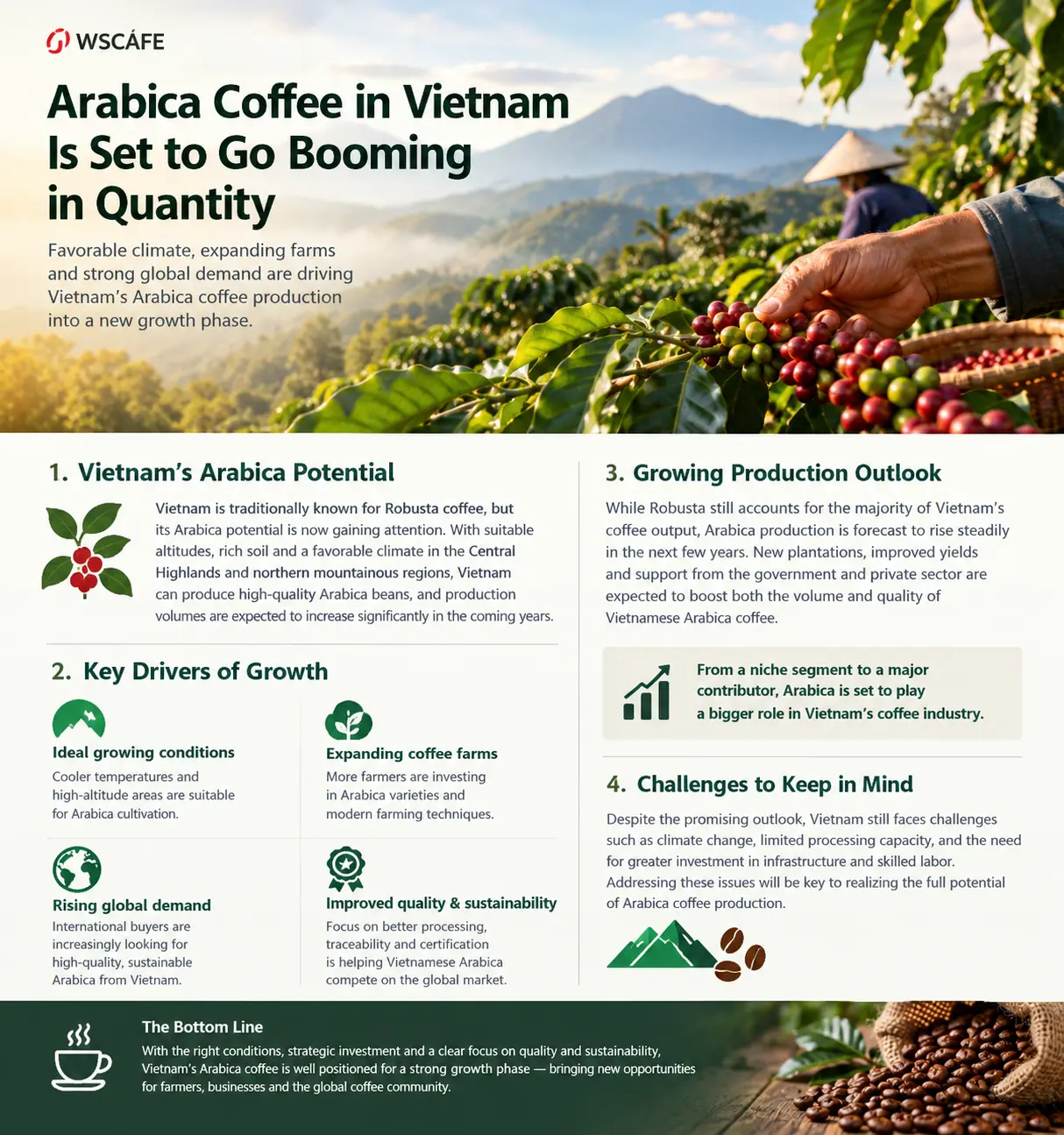
Today, Arabica remains much smaller in volume than Robusta, but production is becoming increasingly concentrated in regions with suitable climates and growing expertise. Son La in northern Vietnam and Lam Dong in the Central Highlands are particularly important Arabica-producing areas.
The story of Vietnamese Arabica is therefore not simply about producing more coffee. It is increasingly about origin, quality, processing, traceability and value.
What Is Arabica Coffee?
Arabica, scientifically known as Coffea arabica, is one of the two major coffee species traded globally, alongside Robusta (Coffea canephora).
Arabica is generally associated with greater aromatic complexity and a wider range of flavor characteristics. Compared with Robusta, Arabica typically has lower caffeine content and is often used in specialty and premium coffee markets.
However, Arabica is not automatically better than Robusta. Cup quality depends on many factors, including:
- Genetic variety
- Growing altitude
- Climate
- Soil
- Harvesting practices
- Cherry ripeness
- Processing method
- Drying
- Storage
- Roasting
- Brewing
This is particularly important when discussing Vietnamese Arabica because the country has a wide range of growing environments.
A Brief History of Arabica Coffee in Vietnam
Vietnam's coffee story began with Arabica.
Coffee was introduced to Vietnam during the French colonial period in the 19th century. Over time, however, Robusta became much more important because it adapted well to Vietnam's major coffee-growing regions and offered high productivity.
The expansion of Robusta eventually transformed Vietnam into a major global coffee producer.
In addition to that, it is rumored that the other major force that motivates robusta expansion is the then Vietnamese authorities with the consultation by the scientists decided to grow robusta which commits more success to help local farmers to fight against poverty and famine.
After all, Arabica followed a different path.
Its production is more dependent on suitable temperatures and elevation, and the plant can be more vulnerable to diseases such as coffee leaf rust. As a result, Arabica cultivation became concentrated in selected mountainous areas rather than spreading across the main Robusta-growing belt.
Today, Vietnam's Arabica sector remains relatively small compared with Robusta, but selected origins have developed strong potential in specialty and higher-value coffee markets.
Where Is Arabica Coffee Grown in Vietnam?
Vietnamese Arabica is concentrated mainly in northern mountainous areas and parts of the Central Highlands.
Among the most recognized origins are:
1. Son La Arabica
Son La has become one of the most important Arabica-producing regions in Vietnam.
The province's coffee-growing areas are generally located at elevations that provide a cooler climate than Vietnam's lowland coffee regions. Arabica cultivation in Son La dates back decades, and the crop has become an important source of income for many farming communities.
By the end of 2024, Son La had approximately 23,312 hectares of coffee, representing about 47.9% of Vietnam's Arabica-growing area, according to a report from the Son La provincial authorities. Production was nearly 30,000 tonnes of green coffee beans.
More recent provincial information indicates that Arabica area expanded further. By the end of 2025, Son La reported approximately 26,120 hectares of Arabica coffee, with estimated green-bean production of about 37,724 tonnes.
This makes Son La one of the most important stories in the development of Vietnamese Arabica.
The province is also moving beyond simply increasing production. Current initiatives emphasize:
- Sustainable certification
- Traceability
- High-quality production
- Specialty coffee
- Processing technology
- Export market development
Son La has set a longer-term goal of developing approximately 25,000 hectares of coffee by 2030, with a focus on quality, traceability and international standards.
Before coffee arrived, the main agro-product of Son La was corn of high quality. With the good price of arabica coffee in recent years, arabica coffee plantation is expected to be speed up in this province.
2. Da Lat and Cau Dat Arabica
The Da Lat area of Lam Dong has a long-standing reputation for Arabica production.
Cau Dat, in particular, is one of Vietnam's best-known Arabica origins. Its high elevation, cooler climate and volcanic-derived soils provide conditions that are well suited to Arabica cultivation.
Lam Dong is the province, and with its other arabica growing origins, eg. Cau Dat, Da Lat, Lac Duong, Dasar, Lam Ha, Dung K'no, Don Duong, etc. Among them, Cau Dat is the oldest and most traditional village for growing arabica coffee with a long history.
Lam Dong also has a substantial Arabica-growing sector. The Intellectual Property Office of Vietnam reported that the province had approximately 16,972 hectares of Arabica in 2022, representing about 10.2% of its total coffee area. In 2025, Lam Dong coffee products received geographical indication protection, further strengthening the region's origin identity.
Cau Dat and other highland areas around Da Lat are particularly relevant to Vietnam's specialty-coffee development.
3. Other Vietnamese Arabica Origins
Arabica is also grown in several other mountainous areas, including parts of:
- Mang Den
- Lai Chau
- Dien Bien
- Quang Tri, most noticeable with Khe Sanh.
- Yen Bai
- Hoa Binh
- Other origins that have already stopped growing arabica: A Luoi (Hue city), Thai Hoa (Nghe An province), Yen My (Thanh Hoa province).
Each area can produce coffee with different characteristics because of variations in elevation, climate, soil, varieties and processing.
This geographical diversity is one of the most interesting aspects of Vietnamese Arabica.
Why Is Vietnam Suitable for Arabica Coffee?
Arabica generally performs best in cooler environments than those preferred by Robusta.
Vietnam has several mountainous regions where elevation creates significantly cooler growing conditions.
In northern Vietnam, for example, coffee-growing areas in Son La benefit from mountainous terrain and seasonal temperature patterns that are different from the hot, low-elevation environments associated with much of Vietnam's Robusta production.
In the Central Highlands, areas around Da Lat and Cau Dat offer another important Arabica environment.
The combination of:
- Higher elevation
- Cooler temperatures
- Distinct seasonal conditions
- Suitable soils
- Mountainous terrain
creates opportunities for producing Arabica with distinctive regional characteristics.
However, climate suitability alone does not guarantee high-quality coffee.
Farm management, harvesting and post-harvest processing are equally important.
Vietnam Arabica Production Is Growing — But Quality Matters More Than Quantity
Vietnam's overall coffee industry continues to expand and modernize.
The USDA Foreign Agricultural Service forecast Vietnam's 2025/26 coffee production at 31 million 60-kg bags, equivalent to about 1.86 million tonnes of green coffee, with Robusta accounting for approximately 30 million bags and Arabica approximately 1 million bags. This is an inspired number in the situation that many coffee farms have been replaced by durian farms across the Central Highlands recently.
This also illustrates an important point:
Vietnam's coffee industry remains overwhelmingly Robusta-oriented.
Arabica is a much smaller part of national production.
Therefore, the opportunity for Vietnamese Arabica may not be to compete with the world's largest Arabica producers on volume alone.
Instead, Vietnam can potentially create more value through:
Origin + quality + specialty processing + traceability + branding.
This is already visible in regions such as Son La and Lam Dong.
Why Vietnamese Arabica Has Growth Potential
Several factors could support the development of Vietnamese Arabica.
1. More attention to specialty coffee
Vietnam's coffee industry is gradually moving beyond commodity production.
Farmers, cooperatives and processors are experimenting with selective harvesting, improved fermentation, controlled drying and other techniques that can help express the characteristics of specific origins.
2. Better processing technology
Arabica quality can be strongly influenced by post-harvest processing.
Traditional washed processing remains important, particularly in regions such as Son La, while natural, honey and experimental fermentation methods are increasingly relevant to specialty production.
Better equipment and processing knowledge can help reduce defects and improve consistency.
3. Growing interest in origin-specific coffee
International buyers increasingly look for traceable coffees with identifiable origins.
Instead of simply selling:
"Vietnam Arabica"
a producer can potentially offer:
"Son La Arabica — specific district, altitude, variety and processing method."
This creates a much stronger product story.
4. Sustainable production
Sustainability is becoming increasingly important for international coffee buyers.
Son La has already developed substantial areas under sustainability certification. In 2025, local authorities reported more than 23,000 hectares associated with sustainable certification programs and continued efforts to improve traceability and production standards.
The Challenges Facing Vietnamese Arabica
The future is promising, but Arabica production in Vietnam faces several challenges.
Climate change
Changes in rainfall, temperature and extreme weather can affect flowering, fruit development and harvest timing.
Climate change is particularly important for Arabica because the crop generally requires a narrower climatic range than Robusta.
Coffee leaf rust
Coffee leaf rust remains an important disease risk for Arabica producers.
Plant breeding, farm management and disease monitoring are therefore essential for maintaining stable production.
Difficult terrain
Many Arabica farms are located in steep mountainous areas.
This creates challenges for:
- Mechanization
- Transportation
- Harvesting
- Processing infrastructure
- Logistics
The same mountainous conditions that make some locations attractive for Arabica can also increase production costs.
Processing capacity
High-quality Arabica requires careful post-harvest handling.
In wet-processing regions, water management and wastewater treatment are also important environmental considerations.
For example, authorities in Son La have highlighted the challenge of managing coffee pulp and wastewater generated by wet processing.
While washed or fully washed method is the best practice for processing arabica, some areas still apply unwashed for arabica which downgrades the value of this type of coffee.
From Commodity Coffee to Specialty Vietnamese Arabica
One of the most interesting developments is the shift from thinking about Arabica simply as a crop to thinking about it as an origin-based specialty product.
A coffee buyer may be interested in much more than the species.
They may want to know:
- Where was it grown?
- At what altitude?
- Which variety?
- When were the cherries harvested?
- How were they processed?
- How were they dried?
- What certification does the farm have?
- What is the cup profile?
- Can the supply be traced back to the producer?
These questions create opportunities for Vietnamese Arabica producers to capture more value.
What Does Vietnamese Arabica Taste Like?
There is no single flavor profile for Vietnamese Arabica because the country has many growing regions and varieties.
Depending on origin and processing, Vietnamese Arabica may display:
- Floral aromas
- Citrus or other fruit notes
- Chocolate
- Caramel
- Nuts
- Brown sugar sweetness
- Mild to bright acidity
- A clean or balanced finish
Cau Dat Arabica, for example, has developed a reputation for its distinctive highland character, while Arabica from Son La can offer a different sensory profile shaped by its northern mountainous environment.
This diversity is one reason Vietnamese Arabica deserves greater attention from specialty coffee buyers.
Can Vietnam Become a Major Arabica Producer?
Vietnam is unlikely to transform its coffee industry into an Arabica-dominated system in the same way that it became a global powerhouse in Robusta.
Robusta is deeply established in the Central Highlands, supported by extensive infrastructure, farmer experience and established supply chains.
Instead, the more realistic development path for Arabica is targeted expansion in suitable locations.
The emphasis is likely to be on producing higher-value coffee rather than simply maximizing hectares.
One factor to back the idea of "higher-value for arabica coffee" is that property's prices in Vietnam now are too expensive for new farmers to start growing arabica. The high-anchoring price for a farm acquisition will discourage any business ideas as they find no way to earn profits.
USDA forecasts for Vietnam's 2025/26 crop illustrate this structure: approximately 30 million bags of Robusta compared with about 1 million bags of Arabica.
Therefore, Vietnamese Arabica's future may be defined less by its share of national production and more by its ability to establish recognizable origins and compete in higher-value segments.
The Future of Vietnamese Arabica
Vietnam's coffee industry is entering a period in which value may become as important as volume.
For Robusta, Vietnam already has enormous scale.
For Arabica, the opportunity is different.
The combination of suitable mountainous areas, experienced farmers, improving processing technology, sustainability programs and growing international interest in origin-specific coffee could help Vietnamese Arabica establish a stronger position in the global specialty market.
Son La is expanding its Arabica industry while investing in traceability, certification and quality. Lam Dong continues to develop recognized Arabica origins around Da Lat and Cau Dat.
The next chapter of Vietnamese Arabica is therefore unlikely to be simply:
"How much more coffee can Vietnam produce?"
It may instead be:
"How much more value can Vietnam create from each kilogram of Arabica?"
That shift—from volume to value—could become one of the most important developments in Vietnam's coffee industry.
Frequently Asked Questions About Vietnam Arabica Coffee
Is Vietnam known for Arabica coffee?
Vietnam is much better known for Robusta, but the country also produces Arabica in several mountainous regions, particularly Son La and Lam Dong.
Where is the best Arabica coffee in Vietnam grown?
Cau Dat near Da Lat and Son La are among the country's best-known Arabica origins. However, "best" depends on variety, farm, processing method, roast and individual taste.
Does Vietnam produce Arabica coffee?
Yes. USDA's 2025/26 forecast puts Vietnamese Arabica production at approximately 1 million 60-kg bags, compared with about 30 million bags of Robusta.
Is Vietnamese Arabica specialty coffee?
Some Vietnamese Arabica is produced as specialty coffee, particularly from origins such as Son La and Lam Dong. However, not all Vietnamese Arabica should automatically be classified as specialty coffee.
What is the difference between Vietnamese Arabica and Robusta?
Vietnamese Arabica generally grows in cooler, higher-elevation environments and is often associated with greater aromatic complexity and lower caffeine than Robusta. Robusta is more widely cultivated in Vietnam and remains the country's dominant coffee species.
What are the main Vietnamese Arabica origins?
Major and emerging origins include Son La, Da Lat/Cau Dat in Lam Dong, Lai Chau, Dien Bien and Quang Tri.
Conclusion
Vietnam will continue to be strongly associated with Robusta, but its Arabica story is becoming increasingly important.
From the highlands of Cau Dat and Da Lat to the mountainous coffee farms of Son La, Vietnamese producers are demonstrating that the country can produce Arabica with distinctive regional identities.
The sector still faces challenges—from climate change and disease to difficult terrain and processing infrastructure—but investment in quality, sustainability, traceability and specialty processing is creating new opportunities.
For international coffee buyers, Vietnamese Arabica is a category worth watching—not simply because production may grow, but because the country's diverse origins have the potential to create distinctive, higher-value coffees.